
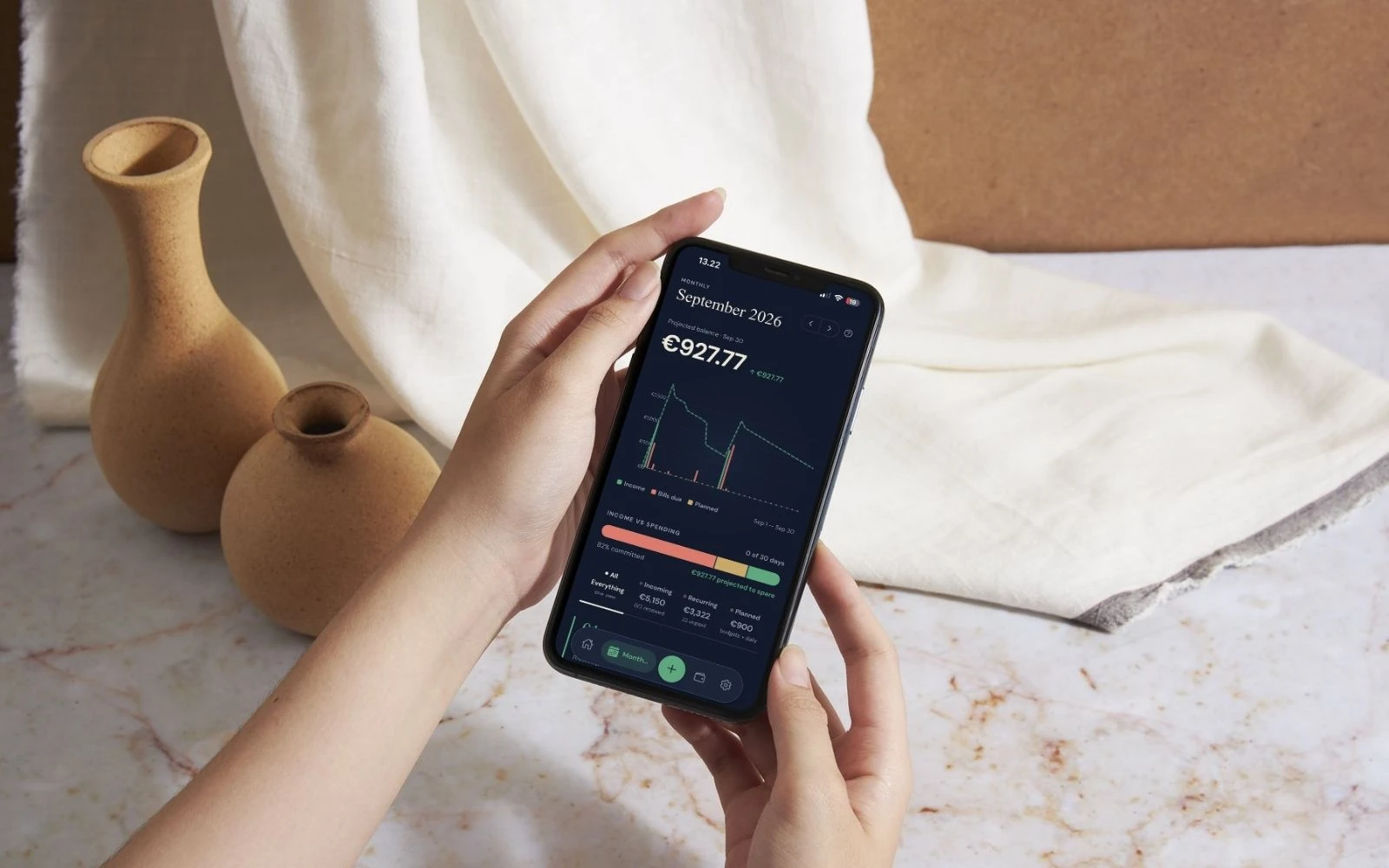
A monthly budget that shows the month ahead
A monthly budget in three steps: bills first, then what's left, and how much that is per day. Plus payday timing and what to do when the month slips.
The month isn’t too short. It’s just invisible.
That’s the whole idea of a monthly budget in one sentence. Not writing down every euro and feeling guilty when the numbers don’t match. Seeing the month before it happens, so the 25th stops being a surprise.
This is more timely than most people guess. According to a Danske Bank study reported by Yle in August 2026, 38 percent of Finns have no financial buffer at all; in Sweden the figure is 22, in Denmark 21. And in a January 2026 study by Finance Finland, 39 percent don’t save or invest anything.
That doesn’t mean 39 percent of people are bad with money. It means a lot of people are living their month without a map. Here’s how to draw one: three steps, each one something anyone can do.
What a monthly budget is (and what it isn’t)
An old but still solid guide from the Finnish consumer authority defines it in refreshingly boring terms: a budget is an estimate, a plan of income and expenses, whose purpose is to size your spending to your income. Martat, the Finnish home economics organisation, puts the same thing more warmly: budgeting means dividing your money in advance and giving every euro a job.
Note the word estimate. A budget is not a promise. It is not a diet. It’s a map, and you’re allowed to correct it along the way.
A budget isn’t a promise. It’s a map: bills first, then the days.
Step 1: income, and when it arrives
Most budgeting guides start with “add up your income”. Good start, but it skips the one thing that causes much of the end-of-month squeeze: when the money lands.
For many people the salary arrives on the 15th or on the last day of the month. Benefits have their own schedule: in Finland, housing allowance and student financial aid from Kela are paid on the first banking day of the month, child benefit on the 26th. Rent usually leaves at the start of the month. The electricity bill leaves whenever it feels like it.
So write your income down with its dates. If the salary arrives on the 15th and the rent leaves on the 1st, your month doesn’t really start on the 1st, and that’s worth knowing before you plan the rest of it.
Step 2: bills first
The order recommended by Takuusäätiö, a Finnish foundation focused on financial wellbeing, is clear: income first, then fixed costs like housing, food and medicine, and only then everything else. Write down every bill with its due date: rent or maintenance charge, electricity, internet, phone, insurance, loan payments, subscriptions (all of them; if you haven’t listed those yet, here’s a reason to).
Then the part many people skip: irregular bills. Insurance once a year, vehicle tax, the dentist, Christmas. They aren’t surprises; they just come rarely. Divide the yearly amount by twelve and set that much aside every month, and the money for November’s insurance bill is already waiting in June. (In Prsperous this is what the holding account is for: a place where money sits waiting for a specific bill. But the idea works with an ordinary savings account or on paper.)
Once the bills are listed, add them up. That number is the fixed part of your month. It doesn’t flex, so it’s worth knowing.
Step 3: what’s left, and how much per day
Now comes the step that separates a budget that works from all the ones that got started and abandoned.
Takuusäätiö offers a direct formula: a daily budget is take-home income minus fixed costs, divided by the days in the month. Simple, and that’s exactly why it works.
A made-up example: take-home income €2,400, bills and a savings transfer €1,650 in total. That leaves €750. Divided by thirty, it’s €25 a day, for food, the bus, coffee, all the life that isn’t bills.
Why does this matter so much? Because “€750 for the rest of the month” is an abstraction. “€25 today” is something you can live with. You can make choices with it in the supermarket. And if €40 went out today, you know immediately that tomorrow has a little less. Not at the end of the month. Tomorrow.
This is the same number Prsperous calculates every day and shows as your safe-to-spend amount. If you want to know exactly what it tracks and why it isn’t the same as your account balance, that post explains it.
50/30/20, and the Finnish reality check
Almost every budgeting guide mentions the 50/30/20 rule: half for necessities, 30 percent for wants, 20 percent for savings. The rule comes from Elizabeth Warren and Amelia Warren Tyagi’s book All Your Worth from 2005, and it’s a good compass.
But it’s a compass, not a ruler. According to Statistics Finland, Finnish households spend on average about 59 percent on necessities, and housing alone, energy included, takes roughly a third; for the lowest-income fifth it’s nearly 40 percent. So for many people “50 percent for necessities” is unrealistic from the start, and that’s nobody’s fault.
Which is why your own numbers always beat a general rule. How much should go to savings is your call and your situation; we won’t advise on that, but we’ll give you the tools to see it.
What about when the month doesn’t go to plan?
Sometimes it won’t. The car breaks, the week was rough, the order button got pressed. Traditional budgeting advice treats this as failure: “be more disciplined, try again next month”.
We think about it differently. If on the 12th you notice more money has gone out than planned, the month isn’t ruined. You have 18 days left, and they get a new number. That’s the whole point of a daily budget: a mistake doesn’t pile up at the end of the month, it spreads across the days that remain. A small correction for a small situation.
Financial and debt counsellor Maija Nykänen told Yle something worth remembering: budgeting gives you certainty, but also freedom in everyday spending. When you know what you can afford, you can spend it in peace.
Two special cases:
- The five-week month. If you’re paid once a month, a few months a year are effectively a day or two longer. Divide by the real number of days, not always by thirty.
- The month where bills pile up. Insurance plus electricity plus the car service, all in the same month. If you’ve been setting aside for irregular bills every month (step 2), this month is no different from the others. If you haven’t, it’s a good reason to start next month.
A monthly budget for two
If you share your finances with someone, the three steps stay the same, but each one gains an extra question: whose? Whose income, whose bills, what counts as shared. And at the end, two numbers instead of one: how much each of you has safe to spend.
That’s a topic of its own, and it has its own post. For now one principle is enough: both of you need to see the same month. When one sees the bills and the other sees the groceries, neither sees the whole.
Paper, a spreadsheet, or an app?
Honest answer: they all work. A monthly budget doesn’t require software, and if squared paper feels most natural, use squared paper. There are free tools too: Takuusäätiö’s budget calculator does steps 1 and 2 in the browser, and the same foundation’s Penno service is free of charge.
What an app adds is step 3 without the arithmetic: when you log the day’s purchases, tomorrow’s number updates by itself. Prsperous does exactly this, and you can start without bank credentials, by entering your income and bills yourself. Here’s how it works.
But the tool is secondary. What matters is that the month is visible before it happens. And that’s possible for absolutely anyone, including whoever has spent their whole life so far convinced they’re “not a numbers person”.
Stay on track. Reach your goals.
Prsperous gives you tools and clarity, not financial advice.