What a couple spends per month, by age group
What a two-adult household in Finland earns and spends at 18–44, how much is left per day for two, and why moving in together pays off more than it feels.
When two people move in together, something happens that neither of them usually calculates: income roughly doubles, but costs don’t. The rent doesn’t double. The electricity bill doesn’t double. The internet costs the same. A two-adult household is one of the most financially efficient ways to live, and yet many couples feel money is tighter than it was living alone.
The reason is rarely the money. The reason is that neither of them sees the whole.
This is part two of a two-part series. Part one calculated how much someone living alone has left at different ages. Now we do the same for a two-adult household: what a couple earns, where it goes, and how much is left per day, together and per person. The figures come from Statistics Finland, the Centre for Consumer Society Research, Kela and Helsinki region transport, and every one is linked. And as in part one: these are medians and examples, not instructions.
How many people live as a couple, and when
According to Statistics Finland, in 2025 about 20 percent of 18–24-year-olds, about 52 percent of 25–34-year-olds and about 64 percent of 35–44-year-olds lived in a relationship. In the youngest group nearly all couples are cohabiting; by 35–44, marriage is already the more common form.
Which means a two-person budget is, for most people, a 25–34 thing, right when salaries climb fastest and housing choices get made.
What a two-adult household earns
Instead of individual salaries, we now look at households. Statistics Finland’s total income distribution statistics show what a two-adult household has left after taxes, benefits included: real, disposable money. Medians for 2024, divided to a monthly level:
| Household | Age of reference person | Disposable €/mo |
|---|---|---|
| Two adults, no children | 15–24 | ~2,850 |
| Two adults, no children | 25–34 | ~4,660 |
| Two adults, no children | 35–44 | ~5,080 |
| Two adults with children | 25–34 | ~5,010 |
| Two adults with children | 35–44 | ~5,940 |
Disposable money income, median, 2024. Source: Statistics Finland.
For comparison: the same figure for a one-person household at 25–34 is about €2,120 (from the same statistics; part one’s €2,270 is personal income from a different table). So a couple’s income isn’t double but roughly 2.2 times, because a two-adult household more often has two earners. But the costs are not 2.2 times. We’ll come back to that.
What life for two adults costs
In the reference budgets from the Centre for Consumer Society Research, a working couple’s decent minimum for daily costs, excluding housing and transport, is about €1,170 a month: food €567, clothes €111, hygiene €82, health €47, connectivity and home electronics €132, leisure €97, household goods about €70, electricity and insurance €59. (The reference couple is calculated for over-50s; for younger couples the numbers are probably in the same range, but it’s worth knowing.)
Compare that with the same figure for one person, about €610–680. So two people’s daily costs are roughly 1.8 times one person’s: food doesn’t really get cheaper, but internet, electricity and household goods get shared. And the thing that truly changes is housing.
Housing for two. According to Statistics Finland, the median rent for a market-rate one-bedroom flat in summer 2026 was €950 in Helsinki, €779 in Tampere, €715 in Turku and €660 in Oulu. A studio in Helsinki cost €730. A couple in a one-bedroom flat pays €475 per person for housing, while someone alone in a studio pays €730. That €250 difference per person is a two-adult household’s single biggest advantage, and it’s also the money that vanishes most easily, because neither partner experiences it as a saving.
Transport for two. Two HSL AB monthly tickets cost €147.80 a month in 2026. One car, at the reference budget’s assumption, €530. Two cars: well, you can do that maths yourself.
18–24: two small incomes, one rent
A young couple’s household is often two students, or a student and a first-jobber. Statistics Finland’s median for two adults under 25 is about €2,850 a month in hand, benefits included: slightly more than one full-time worker aged 25–34 nets alone.
An illustrative month in Tampere: one-bedroom flat €779, electricity and insurance €60, two phone plans, internet and subscriptions €100, public transport for two €100, €100 to savings (example figure). Fixed costs €1,139, leaving about €1,700, roughly €57 a day for two, €28 per person.
That’s double the €14 a day of the student living alone. A shared household is financially a smart move when you’re young, and it’s also the age when the habits of talking about money get formed. Build the shared view now, and it exists later too.
25–34: the two-salary decade
This is the age group where a two-adult household is most common, and where the gap to living alone is widest. The median leaves about €4,660 a month in hand.
An illustrative month in Helsinki: one-bedroom flat €950, electricity and insurance €60, two phone plans, internet and subscriptions €130, two HSL tickets €148, €460 to savings (an example figure, about ten percent). Fixed costs €1,748, leaving about €2,900, roughly €97 a day for two, €48 per person.
Compare part one’s solo 25–34-year-old in Helsinki: €45 a day. As a couple, €48 per person. On the same salary level, in the same city, a two-adult household gives each partner slightly more per day, and moves €460 a month into savings as a household. That’s the mathematics of moving in together that nobody says out loud.
And then why it doesn’t feel that way: €97 a day across two cards and two accounts, with no shared number, is practically an invisible sum. Each partner spends their own “reasonably”, and at the end of the month you both wonder where it went. The reference budget’s decent minimum for daily costs is about €975 a month for two, or about €33 a day. The gap between €97 and €33, a good €60 a day, is two people’s shared room to choose. It’s a big number. It’s also the easiest number to lose track of.
A two-adult household isn’t double the income. It’s double the income and clearly less than double the costs, if you can see it.
35–44: when children rewrite the bill
At 35–44, a childless couple has a median of about €5,080 a month in hand and a family with children about €5,940. The family figure is higher because child benefits are included and because parents are, on average, further along in their careers. But the cost side changes more than the income side.
There is no single figure for what a child costs. Three anchors: child benefit from Kela is €94.88 a month for the first child; the early childhood education fee is capped from August 2026 at €335 a month for the first child and €134 for the second; and according to the University of Helsinki’s reference budgets, the decent minimum for a family of two parents and 2–3 children is €3,001–4,567 a month including housing; in Yle’s calculator, a family with three teenagers tops €4,500.
An illustrative month for a family outside the capital region: a two-bedroom flat or mortgage payments €950, electricity and insurance €80, phone plans, internet and subscriptions €130, car €530, early childhood education €335, €590 to savings (example figure). Fixed costs €2,615, leaving about €3,300, roughly €110 a day for the whole family. That sounds like a lot until you remember it covers food, clothes, hobbies and everything else for three or four people. In the reference budget, food for two adults alone is €567 a month; with children, clearly more.
In this age group the fixed part grows: mortgage, car, daycare, insurance. And that’s exactly why, at this age, the monthly budget is worth building bills first: the daily amount is what’s left, not what you start from.
A realistic daily budget for two
A summary, all illustrative, sized to the statistics:
| Situation | In hand €/mo | Fixed €/mo | Left €/day | Per person |
|---|---|---|---|---|
| Young couple, 18–24, Tampere | 2,850 | 1,139 | ~57 | ~28 |
| Couple, 25–34, Helsinki | 4,660 | 1,748 | ~97 | ~48 |
| Family, 35–44, car, outside Helsinki | 5,940 | 2,615 | ~110 | ~28–37 |
| Reference budget minimum, couple, daily costs | — | — | ~33 | ~16 |
In the light of these numbers, a realistic daily budget for two working adults in Finland lands somewhere between €90 and €100, of which about a third is what the decent minimum already requires. For a family with children the figure is in the same range but shared across more people. And as with living alone: if your own number is clearly smaller, the reason is usually housing or the car, not the supermarket.
How to make it work as a couple
Calculating the numbers is the easy part. The hard part is two people seeing the same number.
Three steps, the same as solo, but each one gains the word shared:
- Shared income. Both partners’ net incomes, or if you keep your money separate, the amount each of you brings to the shared pot. How to split that amount fairly is its own post; this one is about how much there is.
- Shared fixed costs. Housing, electricity, internet, insurance, children, the car, shared savings. List them together, once. A surprising number of couples have never done this, and the list is almost always longer than either partner guessed.
- Divide the difference by the days, and decide whether it’s one number for two or two numbers, one each. Both work. What doesn’t work is having no number.
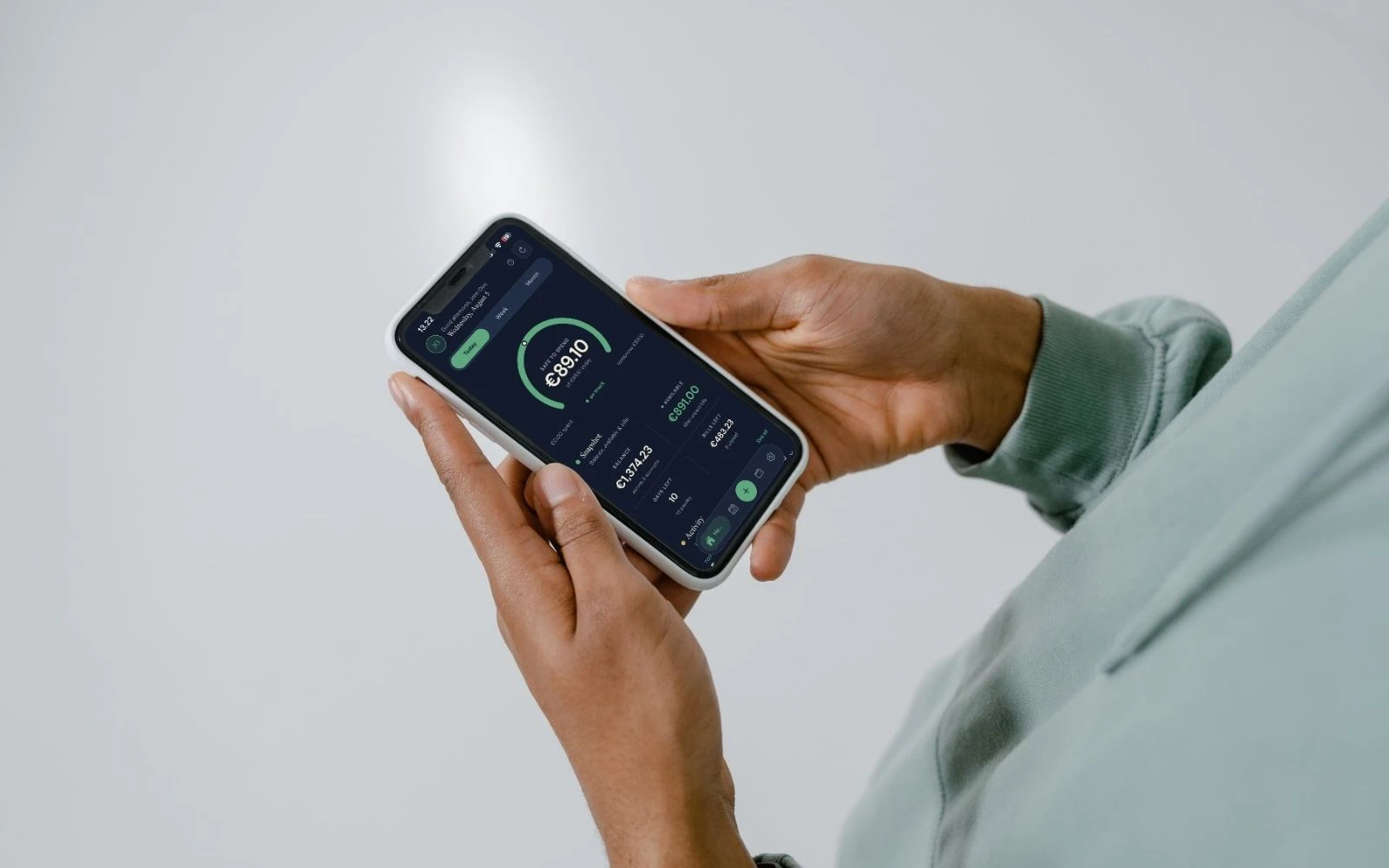
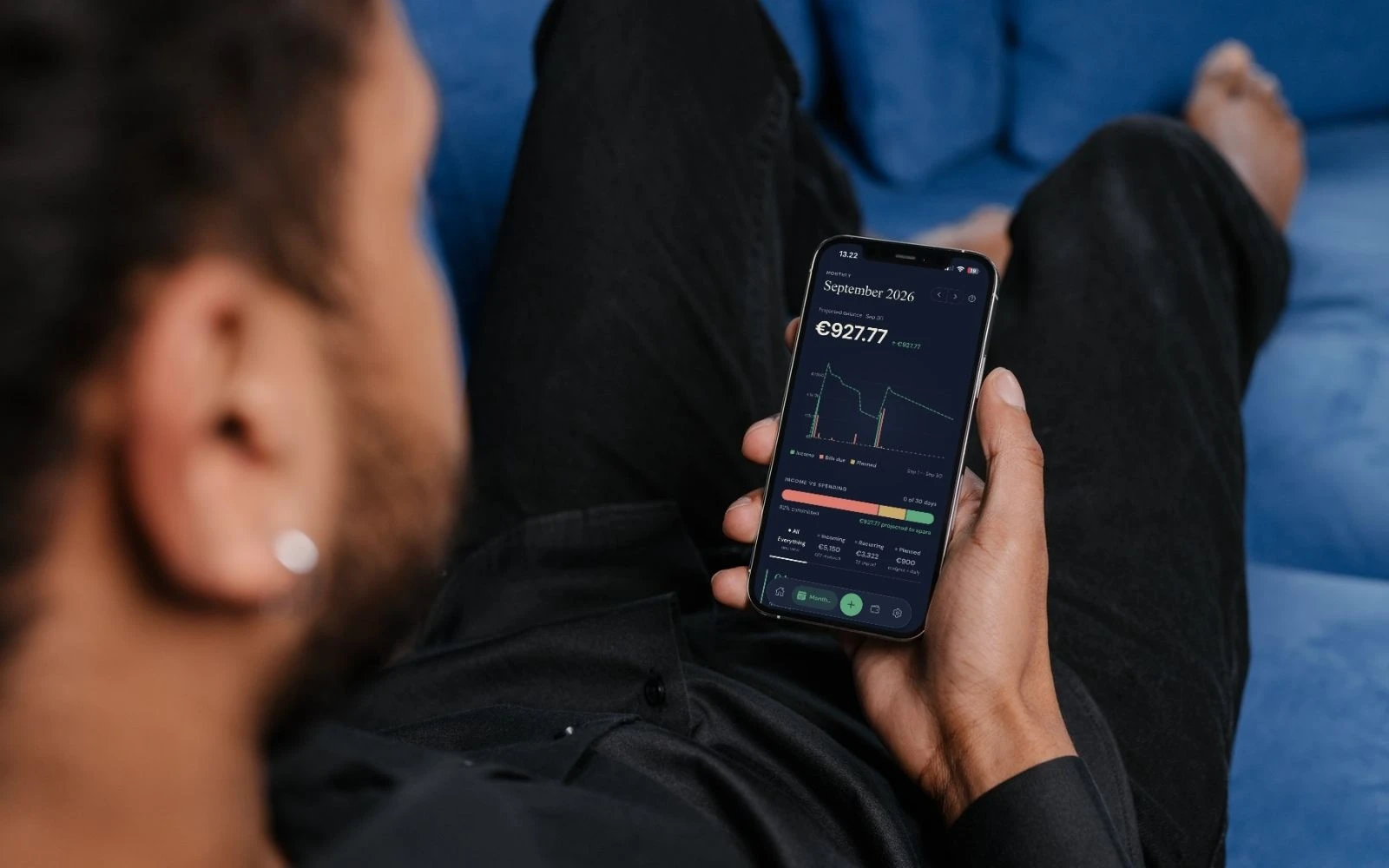
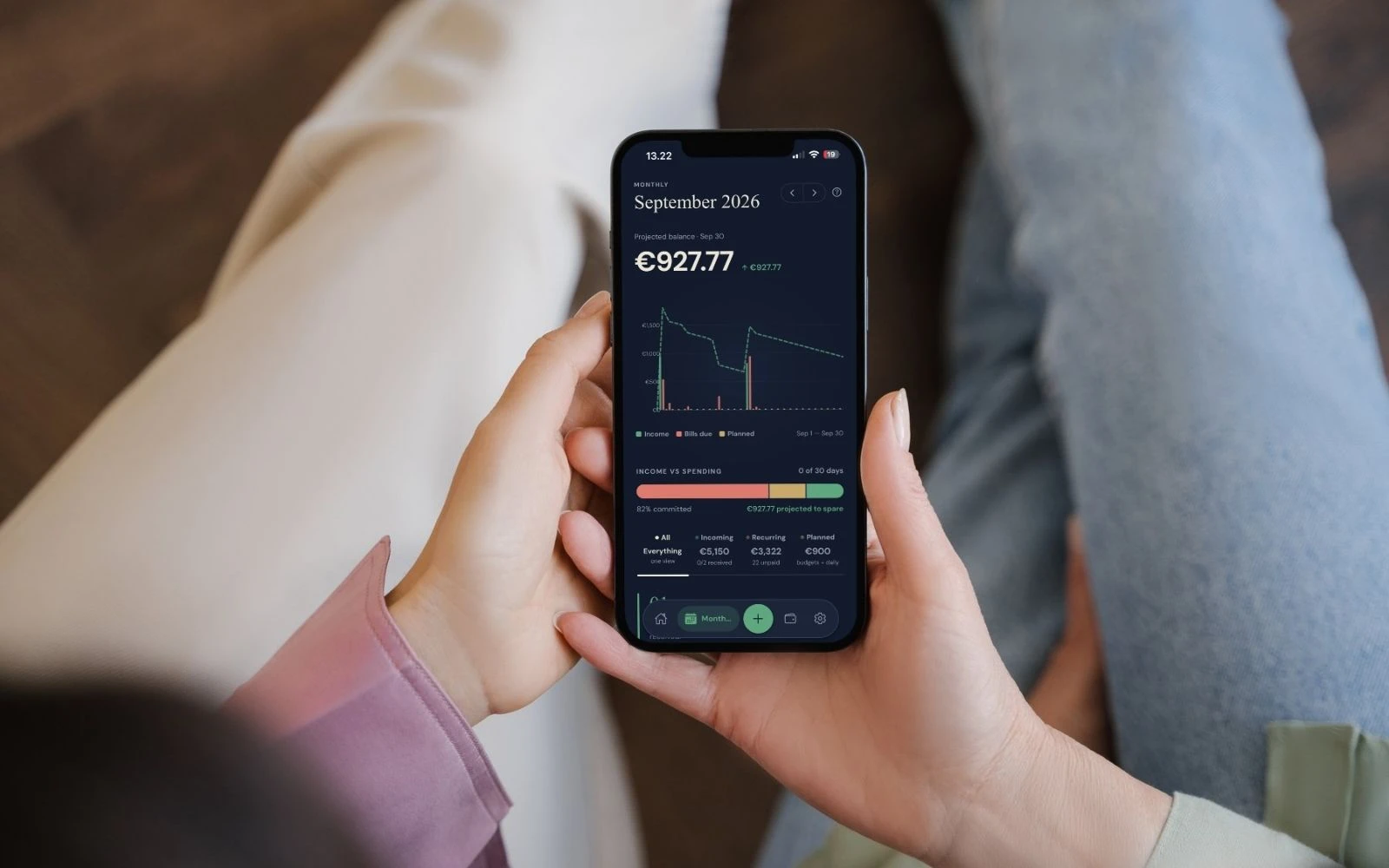
In Prsperous this is built in: a shared pot for shared costs, each partner’s own safe-to-spend number, and settle up for when one of you paid for groceries on behalf of both. Neither of you hands the app bank credentials, and no joint account is needed. The features page has the details, and the FAQ answers whether it really works for couples.
We believe every couple, whatever their age, income or account setup, can get their shared finances visible. It doesn’t require either of you to be good with numbers. It requires one shared number that you both see every day.
Stay on track. Reach your goals.
Prsperous gives you tools and clarity, not financial advice.